

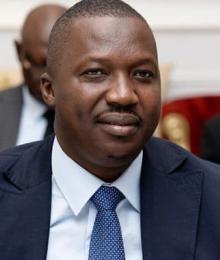
Mamoudou Nagnalen Barry is a Guinean economist, activist, and politician from Kankan, holding several prestigious degrees earned notably at Williams College (United States) and the Académie des Sciences de Management de Paris.
After an international career in finance and development within institutions such as the World Bank, the IFC, and UNDP, he first distinguished himself as a technical adviser to the FNDC citizen movement, which opposed Alpha Condé's bid for a third term, before being appointed Minister of Agriculture and Livestock of Guinea from October 2021 to February 2024.
Since April 2025, he has chaired the board of directors of the Compagnie du TransGuinéen (CTG), playing a central role in steering the giant Simandou mining project, while also pursuing a parallel career as an author published by Éditions L'Harmattan Guinée.
Introduction
Few Guinean career paths illustrate as well the junction between technical expertise, civic engagement, and state responsibility as that of Mamoudou Nagnalen Barry. An economist by training, former World Bank official, leading figure of the FNDC citizen movement, and later Minister of Agriculture and Livestock of the Republic of Guinea, he now holds one of the country's most strategic positions: chairman of the board of directors of the Compagnie du TransGuinéen (CTG), an institutional pillar of the giant Simandou mining project. This article traces in detail his academic, professional, associative, and political journey.
Origins and academic training
Mamoudou Nagnalen Barry was born into a modest Guinean family; he readily describes himself as a "farmer's son," an identity he publicly claimed when he took office as minister, recalling that he was inheriting responsibility for a sector concerning more than 70% of Guinea's population. He is also known as the younger brother of former Sports Minister Siaka Barry, a family link often mentioned in the Guinean press at the time of his appointment.
His schooling began at the Morifindjan Diabaté high school in Kankan, before he enrolled at the Université Générale Lansana Conté (UGLC), where he graduated top of his class in economics and finance — an early sign of the academic excellence that would mark the rest of his career.
This Guinean university path was only the starting point of an impressive international curriculum. In 2013, he received a joint scholarship from the Japanese government and the Bretton Woods institutions to attend a postgraduate program at the Center for Development Economics at Williams College in Massachusetts, United States — one of the most respected institutions for training young officials destined for international financial institutions. He then pursued a doctorate in business administration at the Académie des Sciences de Management de Paris (ASMP), in partnership with the BEM business school in Dakar. To this he added a master's degree in financial strategy, a law degree, and completed the advanced accounting and tax law modules of the chartered accountancy program at INTEC Paris. This accumulation of qualifications makes him one of the most highly credentialed Guinean economists of his generation.
An international career in finance and development
Before entering politics, Mamoudou Nagnalen Barry built a solid career in auditing, finance, and development economics, both in Africa and Southeast Asia. His professional experience took him to numerous countries: Indonesia, Vietnam, Iraq, Lebanon, Kenya, the Democratic Republic of Congo, Chad, Burkina Faso, Côte d'Ivoire, Benin, Guinea-Bissau, and of course Guinea itself.
He began as a Banking Supervisor and Inspector at the Central Bank of the Republic of Guinea (BCRG), before joining the International Finance Corporation (IFC), the private-sector arm of the World Bank, as a consultant in Conakry. He then worked as a National Investment Expert for the United Nations Development Programme (UNDP), under a financing arrangement with the African Development Bank, providing technical assistance to the Agency for the Promotion of Private Investment in Guinea (APIP-Guinée).
Just before joining the government, he held a position as a financial development specialist at the World Bank in Washington. At the time of his ministerial appointment, the Guinean press emphasized that he was presented as a talented young economist working within the World Bank, which reinforced the technical legitimacy of his nomination.
Civic engagement within the FNDC
Alongside his international career, Mamoudou Nagnalen Barry became involved early on in civic activism. He became one of the leading figures of the Front National pour la Défense de la Constitution (FNDC), a Guinean movement that mobilized against former President Alpha Condé's bid for a third term. Within the FNDC, he acted primarily as an adviser on technical and strategic matters, lending his economic expertise to a movement that was above all political and civic in nature.
This engagement earned him international recognition: in 2015, he was selected as a fellow of the Mandela Washington Fellowship, the flagship program of the White House and the U.S. Embassy in Guinea for young African leaders, part of the Young African Leaders Initiative (YALI) launched by President Barack Obama. This distinction confirmed his role as an engaged leader well beyond Guinea's borders.
He is also co-founder of the NGO Organisation pour le Changement Positif, a structure dedicated to promoting good governance and sustainable development in Guinea. His involvement with the FNDC officially ended on October 29, 2021, the date of his appointment to government, on which occasion he formally withdrew from the anti-third-term movement.
Minister of Agriculture and Livestock (2021–2024)
On October 29, 2021, Mamoudou Nagnalen Barry was appointed by decree as Minister of Agriculture and Livestock, within the transitional government led by Prime Minister Mohamed Béavogui, under the authority of the transitional president, Colonel Mamadi Doumbouya. He officially took office on November 1, 2021, in Conakry.
In his inaugural address, he immediately signaled an ambition rooted in fieldwork rather than bureaucracy. He declared his intention to go directly into the fields, farms, and pens before making any decisions affecting rural populations, and stressed the need to end embezzlement and price speculation on agricultural inputs through digitizing the distribution chain. He also articulated a clear vision for the sector, arguing that Guinea must first become an agricultural nation before it could claim mining-nation status.
Describing himself as a "farmer's son," he made clear in his inaugural speech that his mission would not be to reinvent the farmer's hoe, but rather to respond to the concrete needs of farmers — whether the plantain grower in N'Zérékoré, the yam farmer in Kankan, or the market gardener in Mamou or Kindia.
He retained his ministerial portfolio when Bernard Goumou became Prime Minister on August 20, 2022. During this period, he was active in public and diplomatic engagements, notably participating in the first Africa-Caribbean Trade and Investment Forum, where he presented his vision for Guinea's agricultural potential, expressing his desire to attract the sector's largest companies given the country's resources.
On February 19, 2024, the Bernard Goumou government, of which he was a member, was dissolved by the Comité National du Rassemblement pour le Développement (CNRD), ending his ministerial mandate after a little over two years leading the Department of Agriculture and Livestock.
Chairman of the Compagnie du TransGuinéen and architect of Simandou
After leaving government, Mamoudou Nagnalen Barry did not step away from the sphere of major national economic issues. On April 22, 2025, he was appointed chairman of the board of directors of the Compagnie du TransGuinéen (CTG), the entity responsible for managing the rail and port infrastructure linked to the Simandou project, considered Africa's largest integrated mining project.
In this new role, he has become one of the most visible spokespeople for the project. In November 2025, in an interview, he detailed the scale of the expected benefits for the Guinean state, citing roughly one billion dollars in annual revenue for the national budget and growth in the country's GDP from around 20 billion to more than 30 billion dollars. He also outlined extremely ambitious export targets: 40 million tonnes of iron ore in the first year, rising to 120 million tonnes over three years, positioning Guinea as one of the world's leading suppliers of high-grade iron ore, notably for the Chinese market.
He has also emphasized the strategic use of the revenues generated, through the Simandou 2040 program, which provides for financing 122 major infrastructure projects as well as the creation of a sovereign wealth fund for future generations, including a major education component led by the Simandou Academy.
In June 2026, at Guinea's Entrepreneurship and Employment Fair (SADEN), he addressed another sensitive issue: compliance with local-content requirements. He warned the project's international partners against any attempt to circumvent their contractual commitments to Guinean companies, reminding them that the state has the legal tools needed to enforce the "guineanization" clauses written into the signed agreements. He affirmed his determination to ensure that several billion dollars' worth of Simandou-related contracts genuinely benefit national companies.
An engaged pen: literary work
Beyond his economic and political roles, Mamoudou Nagnalen Barry is also a recognized Guinean author, published by Éditions L'Harmattan Guinée. In 2016 he published the novel L'école des pauvres et des riches (The School of the Poor and the Rich), followed in 2020 by L'odeur de l'argent (The Smell of Money). In 2024, he published a more documentary-style work, Guinée, indiscipline financière et opportunités manquées (Guinea: Financial Indiscipline and Missed Opportunities), which directly reflects his expertise in public finance and his critical reading of national economic management.
Personal life
On a personal note, Mamoudou Nagnalen Barry is the younger brother of former Sports Minister Siaka Barry, a family connection regularly noted in the Guinean press, particularly at the time of his entry into government in 2021.
Conclusion
From Kankan to Washington, by way of Conakry, Mamoudou Nagnalen Barry's career illustrates the trajectory of a man of many roles: rigorous economist, committed activist, hands-on minister, writer, and now institutional architect of the largest mining project in Guinean history. His time in government, though relatively short, was marked by a stated commitment to transparency and closeness to rural populations. His current chairmanship of the Compagnie du TransGuinéen now places him at the heart of Guinea's economic transformation, with the declared ambition of making the Simandou project a lever for development benefiting Guineans directly, both today and for generations to come.