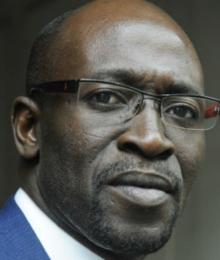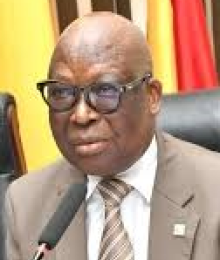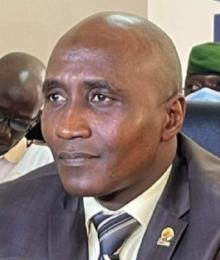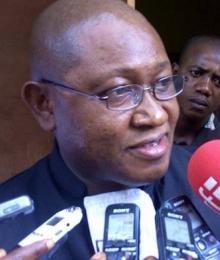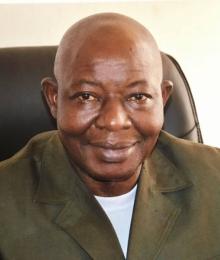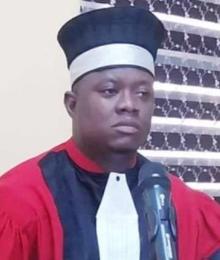



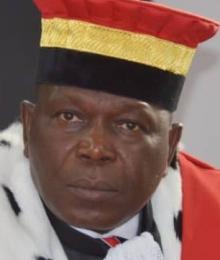
Mohamed Lamine Bangoura is a Guinean magistrate and doctor of law, best known for having presided over the Constitutional Court of Guinea from 2018 to 2021. Previously serving as vice-president of the institution, he assumed its leadership on September 28, 2018 amid an internal crisis, following his role in orchestrating the removal of his predecessor Kèlèfa Sall — a decision promptly endorsed by President Alpha Condé. At the helm of the country's highest constitutional jurisdiction, he positioned himself as a voice for judicial independence, transparency, and institutional renewal.
However, following the 2021 coup d'état, his trajectory took a dramatic turn. Prosecuted by the Court for the Repression of Economic and Financial Offenses (CRIEF) on charges of embezzlement of public funds, corruption, illicit enrichment, and money laundering totaling 20 billion Guinean francs, he was placed in detention at the central prison of Conakry in December 2022. His trial opened on February 18, 2026, during which he categorically denied all charges, declaring himself the victim of an injustice.
Introduction
Mohamed Lamine Bangoura is a prominent figure in Guinea's judicial landscape. A doctor of law, he rose to the presidency of the Constitutional Court of Guinea under particularly turbulent circumstances, before finding himself at the center of a high-profile legal case that encapsulates the country's broader struggle against corruption.
From Vice-President to President of the Constitutional Court
Prior to becoming president of the institution, Mohamed Lamine Bangoura served as vice-president of the Constitutional Court of Guinea. In that capacity, he played an active role in the internal revolt that led, on September 12, 2018, to the removal of the sitting president, Kèlèfa Sall. The latter — known for having publicly warned President Alpha Condé against any attempt to amend the Constitution during the presidential inauguration ceremony in December 2015 — was declared "incapacitated" by his eight colleagues.
On September 28, 2018, the justices of the Constitutional Court unanimously elected Mohamed Lamine Bangoura as the new president. "I was the sole candidate and, consequently, I was elected president of the Constitutional Court unanimously," he declared, pledging to "restore the credibility" of the institution. His appointment was confirmed by presidential decree from President Alpha Condé on October 3, 2018, followed by his official investiture on October 8, at the Court's premises in Conakry, in the presence of several heads of republican institutions.
A Term Marked by Reform… and Controversy
From the outset of his tenure, Mohamed Lamine Bangoura signaled reformist ambitions. He promised a "new era" grounded in the values of collegiality, transparency, independence, and mutual respect. In his end-of-year address for 2019, he outlined an extensive institutional agenda, including organizational strengthening of the Court and staff training, illustrated by a workshop held in Kindia.
However, his presidency remained overshadowed by the very circumstances of his rise to power. The Guinean opposition and segments of civil society strongly contested the removal of Kèlèfa Sall, viewing it as a political maneuver serving the interests of the head of state. Pro-Sall demonstrations were dispersed by security forces, and the diplomatic corps symbolically boycotted the inauguration ceremony of his successor.
Arrest, Detention, and Trial Before the CRIEF
Following the regime change brought about by the 2021 military coup, Mohamed Lamine Bangoura's situation took a drastic turn. In July 2022, the Minister of Justice instructed the Conakry prosecutor's office to initiate legal proceedings against him and several co-defendants on charges of corruption, illicit enrichment, embezzlement of public funds, money laundering, forgery and use of forged documents, and perjury.
Placed in detention at the central prison of Conakry on December 15, 2022, he remained incarcerated despite a conditional release order that was challenged by the special prosecutor of the Court for the Repression of Economic and Financial Offenses (CRIEF). His lawyers denounced a flagrant violation of his fundamental rights and brought the matter before the Supreme Court.
On February 18, 2026, proceedings finally opened before the CRIEF's trial chamber. At the bar, Mohamed Lamine Bangoura categorically rejected the embezzlement charges involving 20 billion Guinean francs, stating: "The Constitutional Court that I led never had a budget of 20 billion. That amount never existed to my knowledge." The Guinean state, represented by its judicial agent, maintained that it would present evidence of guilt in the upcoming hearings.
The case, adjourned to February 23, 2026 for the continuation of proceedings, remains one of the most emblematic in the anti-corruption campaign being pursued by Guinea's transitional authorities.